
AI-Driven Geometry Optimization: The Future of Lightweight Architectural Prints
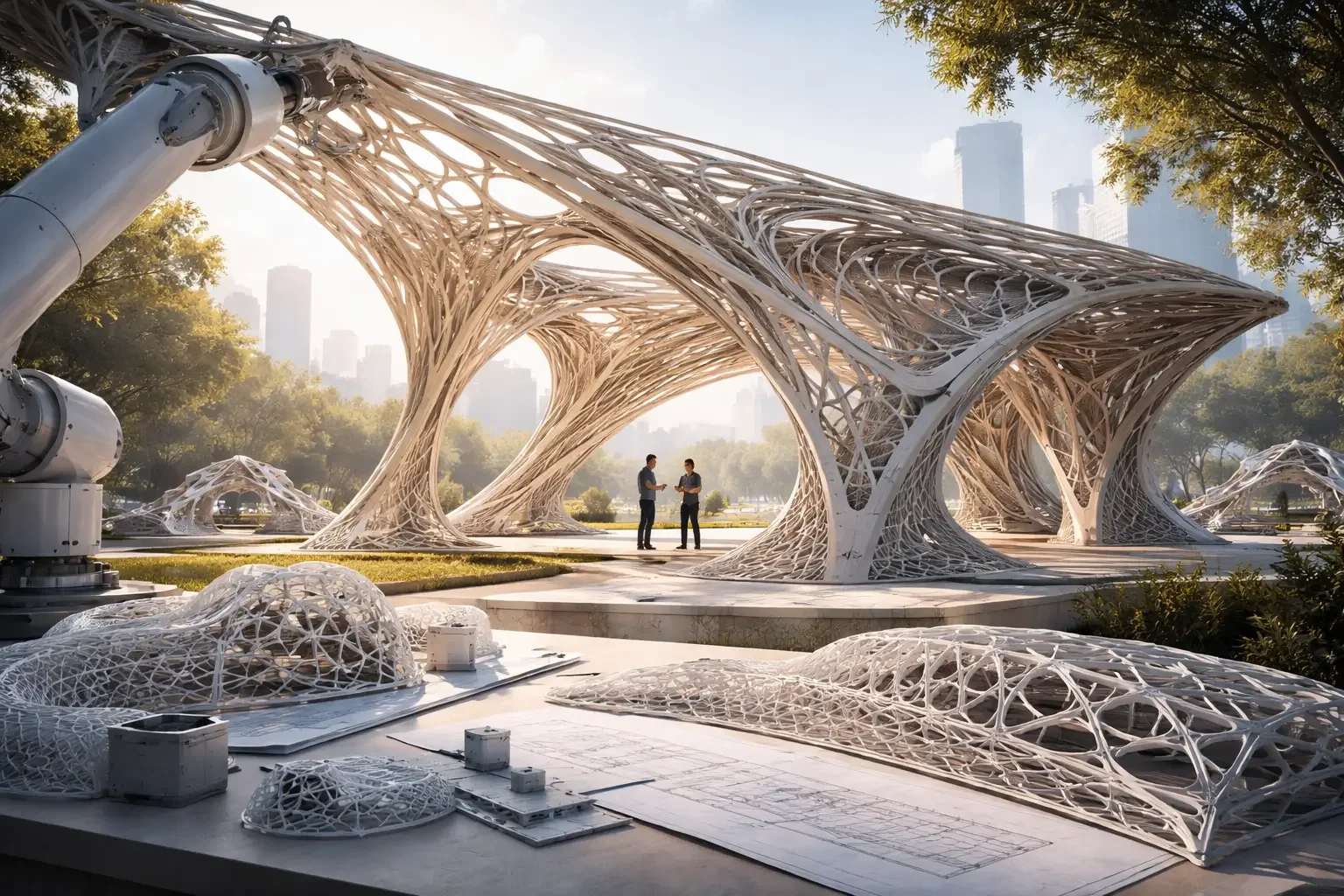
Architecture is entering a new computational era.
As buildings become more complex and sustainability becomes a central design priority, architects are searching for ways to reduce material usage while maintaining structural strength and design freedom.
Traditional design workflows often require multiple iterations of modeling, simulation, and structural testing. This process can be slow and may limit exploration of complex forms.
AI-driven geometry optimization is changing this dynamic.
By combining generative design, structural simulation, and machine learning, architects can now generate structures that are lighter, stronger, and more efficient—many of which are perfectly suited for 3D printing and digital fabrication workflows.
The Challenge of Designing Lightweight Architectural Structures
Architectural structures must satisfy several competing requirements:
Structural integrity
Material efficiency
Fabrication feasibility
Aesthetic intent
Designers often face trade-offs between these factors.
For example, reducing material weight can compromise structural performance, while increasing structural strength may require heavier components. Traditional modeling approaches rely heavily on manual design decisions, which limits the number of possible solutions architects can explore.
This is where AI-assisted design methods offer a powerful advantage.
What Is AI-Driven Geometry Optimization?
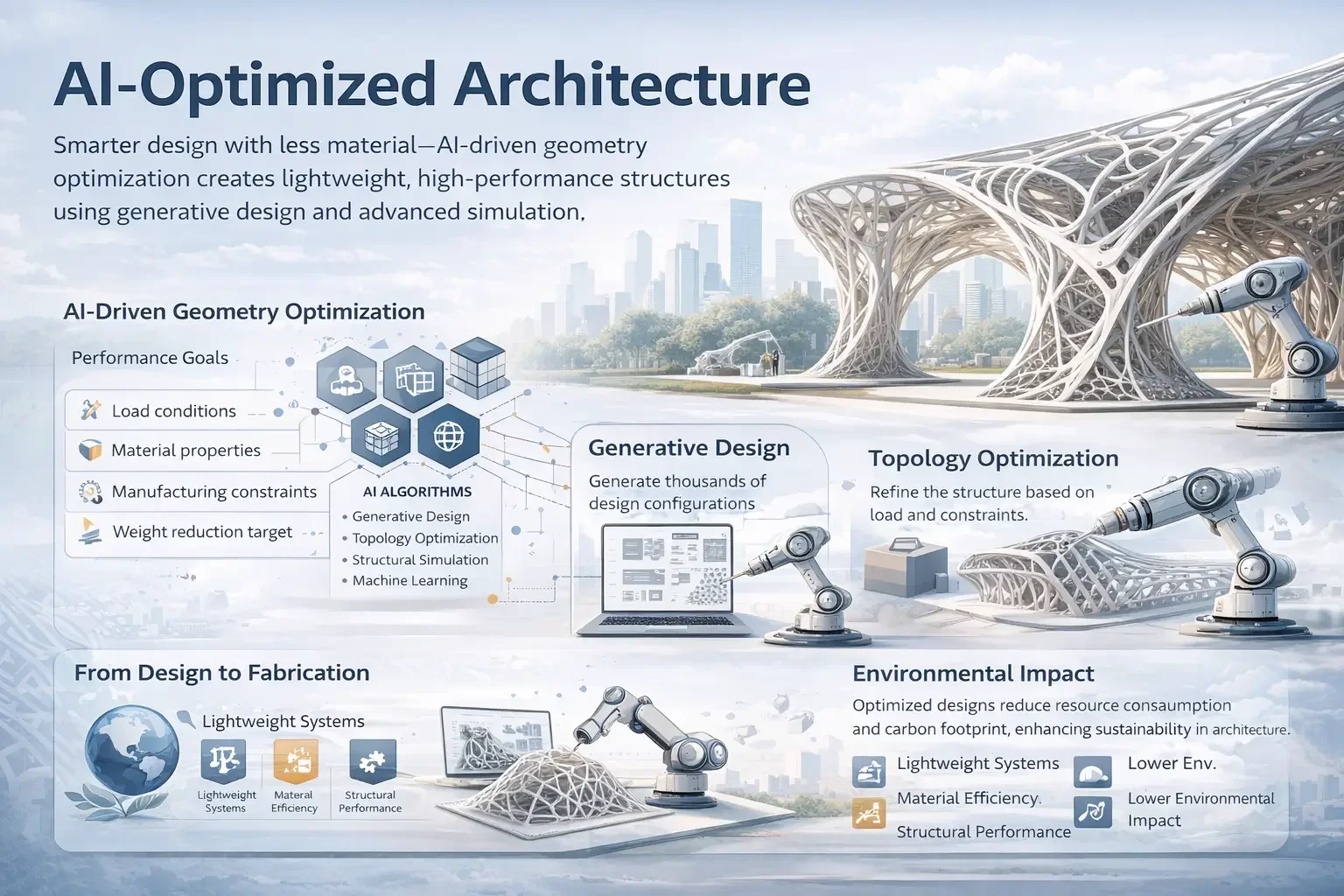
AI-driven geometry optimization refers to computational techniques that automatically generate and refine structural forms based on performance goals.
Instead of designing a structure and testing whether it works, the process begins with constraints and objectives, such as:
load conditions
material properties
manufacturing constraints
target weight reduction
Algorithms then generate geometries that satisfy those requirements.
These approaches often rely on techniques such as:
Topology optimization
Generative design algorithms
Finite element analysis (FEA)
Machine learning-based prediction models
The result is a structure that distributes material only where it is structurally necessary.
Generative Design and Architectural Innovation
Generative design is one of the most transformative aspects of AI-assisted architecture.
Rather than creating a single design solution, generative systems can produce thousands of possible configurations based on a defined set of parameters.
Architects can evaluate these options based on:
structural performance
weight efficiency
fabrication feasibility
aesthetic qualitiesany generative structures resemble organic forms found in nature—such as branching trees, bone structures, or cellular frameworks—because these systems have evolved to maximize strength with minimal material.
This biomimetic approach is becoming increasingly common in computational architecture.
Topology Optimization and Material Efficiency
Topology optimization is a specific computational method used to determine the most efficient material distribution within a structure.
The process works by:
Starting with a solid design space
Applying structural loads and constraints
Iteratively removing material that does not contribute to structural performance
The resulting structures often appear skeletal or lattice-like, with material concentrated only where forces are highest.
For architects, this approach enables the creation of structures that are:
significantly lighter
structurally efficient
visually complex
These geometries are often ideal candidates for additive manufacturing and 3D printed architectural models.
Why AI-Optimized Structures Work Well with 3D Printing
Traditional fabrication methods can struggle with complex geometries produced by generative design and topology optimization.
3D printing, however, allows for much greater geometric freedom.
This makes additive manufacturing particularly useful for:
architectural scale models
structural prototypes
design validation models
experimental fabrication studies
AI-generated lattice structures, organic forms, and optimized frameworks can be reproduced accurately through high-resolution architectural 3D printing workflows.
For architecture studios exploring computational design, this combination of AI optimization and digital fabrication significantly expands the range of possible design solutions.
Sustainability and Material Reduction
One of the most important benefits of AI-driven geometry optimization is its impact on sustainability.
Construction is responsible for a large portion of global material consumption and carbon emissions. Reducing structural material while maintaining performance can significantly lower environmental impact.
AI optimization supports sustainable architecture by enabling:
reduced material usage
lighter structural systems
improved structural efficiency
lower embodied carbon in construction components
As sustainable design becomes a priority in architecture, these computational tools will likely play an increasingly important role.
The Future of AI in Architectural Design
AI-driven design tools are continuing to evolve.
Future systems are expected to integrate additional performance factors, including:
thermal performance optimization
daylight analysis
energy efficiency modeling
environmental impact assessment
Architects may soon be able to generate building systems that simultaneously optimize for structure, climate performance, sustainability, and fabrication feasibility.
This shift represents a broader transformation in architectural practice—from manual design exploration toward data-driven design intelligence.
Conclusion
AI-driven geometry optimization is reshaping how architects approach structural design.
By combining generative design algorithms, topology optimization, and advanced simulation, architects can explore complex forms that are both structurally efficient and materially lightweight.
When paired with modern fabrication technologies such as 3D printing, these optimized geometries can move seamlessly from computational models to physical architectural prototypes.
AI-driven workflows integrate seamlessly with the UK BIM framework and digital construction standards for improved collaboration and efficiency.
As computational tools continue to evolve, AI-assisted design will likely become a central part of the architectural workflow, enabling more sustainable, efficient, and innovative structures.
FAQ
What is geometry optimization in architecture?
Geometry optimization is a computational process that refines the shape of a structure to achieve the best balance between strength, stability, and material efficiency.
What is generative design in architecture?
Generative design uses algorithms to automatically create multiple design options based on defined constraints such as structural loads, materials, and fabrication limits.
What is topology optimization?
Topology optimization is a method that removes unnecessary material from a structure while maintaining structural integrity.
Why are lightweight structures important in architecture?
Lightweight structures reduce material consumption, improve structural efficiency, and can lower the environmental impact of construction.
How does AI help architectural design?
AI helps architects explore more design possibilities, automate structural optimization, and discover forms that would be difficult to create manually.