
Top Trends in 3D Printing for Architects to Watch in 2027
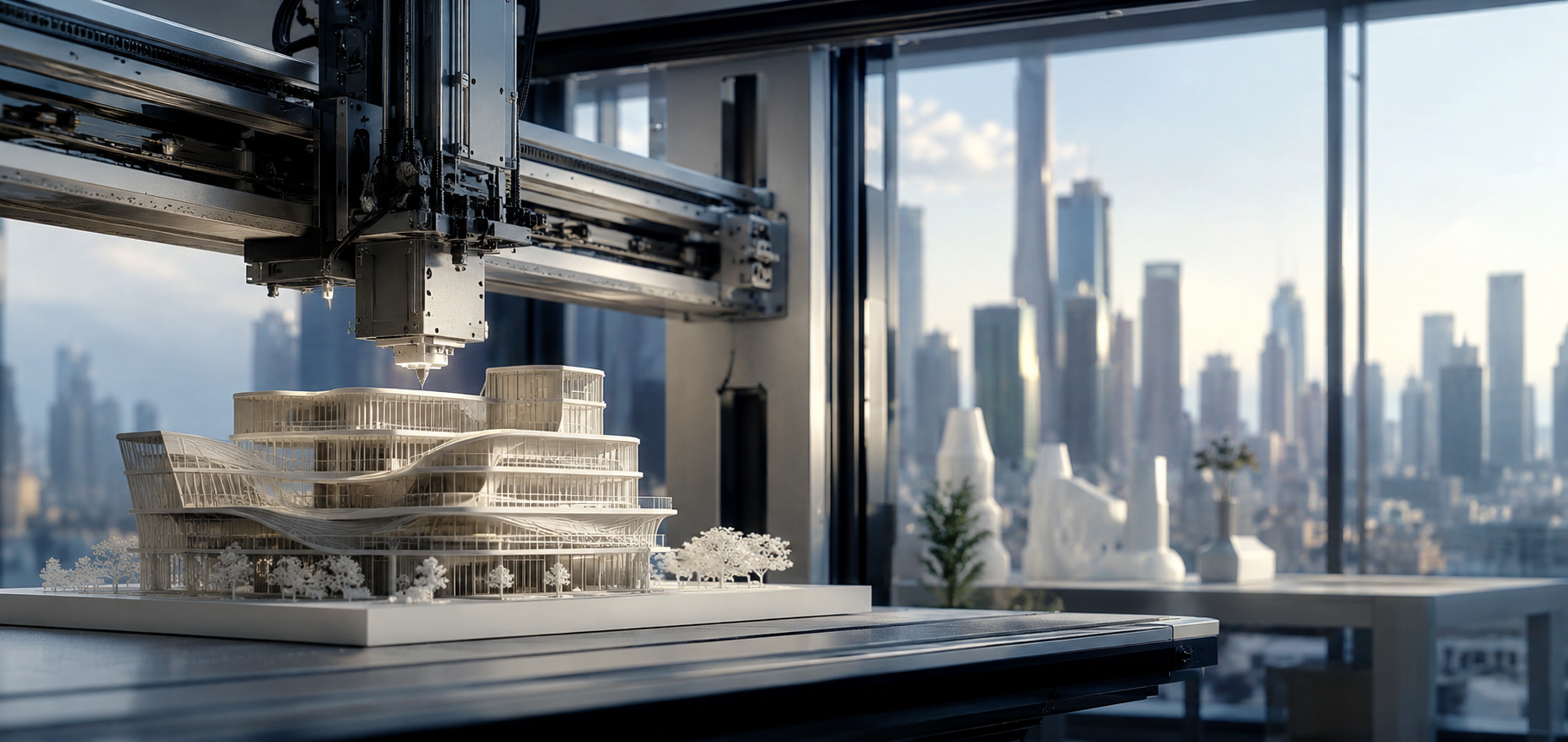
3D printing is moving beyond architectural prototypes and experimental buildings. By 2027, additive manufacturing is expected to become increasingly connected with computational design, robotics, advanced materials, sustainability, and digital construction workflows.
A 2026 review published in Next Materials identifies design flexibility, construction speed, material efficiency, sustainability, robotic printing and advanced materials as major areas shaping the future of construction 3D printing. At the same time, researchers point out that challenges such as material behavior, standardization, structural reliability and regulations still need to be addressed.
For architects, the important question is therefore not simply whether 3D printing will become more common. It is where additive manufacturing can create better architectural, structural, environmental or economic outcomes than conventional fabrication.
Here are the top 3D printing trends architects should watch in 2027.
1. AI-Driven Generative Design Will Connect With 3D Printing
AI and generative design are likely to become increasingly important in architectural fabrication.
Architects can use computational design to explore thousands of potential geometries based on parameters such as structural loads, material consumption, daylight, solar exposure and environmental performance.
The next step is connecting those design systems more closely to manufacturing.
Instead of designing a complex form first and determining later whether it can be manufactured, architects can increasingly design with the capabilities and limitations of the printing process in mind.
Research published in 2026 demonstrates this direction through the combination of topology optimization and robotic additive manufacturing. The study explores fabrication-informed structural design intended to reduce material consumption while maintaining structural and functional performance.
Autodesk Research is also investigating the convergence of AI, 3D geometry, architecture, sustainability and robotics, including neural CAD approaches and AI-assisted design workflows for the AEC sector.
What this means for architects
Architects may increasingly work with systems where they define:
design constraints
performance requirements
material parameters
fabrication limitations
structural objectives
The software can then help generate and optimize printable solutions.
This makes skills in parametric design, computational architecture, generative design and digital fabrication increasingly valuable.
2. Large-Format 3D Printing Will Move Toward Hybrid Construction
Large-format 3D printing is often associated with the idea of printing an entire building.
However, the more practical direction may be hybrid construction, where 3D-printed components are combined with conventional construction methods.
A 2026 review of civil additive manufacturing highlights construction-scale printing as a distinct field with its own material, process, structural and regulatory requirements. It also emphasizes that additive manufacturing needs to be evaluated alongside conventional construction rather than treated as a universal replacement.
This means architects may increasingly specify printed components such as:
walls
façade elements
partitions
structural components
landscape features
interior elements
customized architectural details
while traditional construction continues to handle other building systems.
The result is likely to be a hybrid workflow rather than a completely printed building.
3. Mass Customization Will Become a Major Architectural Advantage
One of 3D printing's strongest advantages is the ability to manufacture customized parts without requiring traditional molds or tooling for every variation.
That makes additive manufacturing particularly interesting for architecture.
Instead of producing hundreds of identical components, architects could create families of related but individually optimized elements.
Examples include:
façade panels
shading systems
screens
acoustic panels
furniture
lighting components
partitions
landscape structures
decorative architectural elements
A 2026 architectural additive-manufacturing guide from Fixie highlights how computational design platforms such as Rhino, Grasshopper and BIM tools can generate complex geometries that are well suited to additive manufacturing.
This convergence of parametric design + digital fabrication could make mass customization increasingly practical.
4. Sustainable Materials Will Become More Important
Sustainability will remain one of the biggest themes in architectural 3D printing.
The layer-by-layer nature of additive manufacturing can allow material to be deposited only where it is needed. Research published in 2026 identifies material reduction as one of the clearest circularity strategies currently being explored in construction additive manufacturing.
Architects should watch developments in:
recycled materials
low-carbon concrete
geopolymer materials
bio-based materials
clay
locally sourced earth
recyclable polymers
material reuse
However, architects should be careful about automatically describing every 3D-printed building as "sustainable."
The 2026 circular-construction review found that environmental evidence remains incomplete: only 41% of the reviewed case studies assessed environmental impacts, and many assessments had limited life-cycle coverage.
In other words, 3D printing can support sustainable design, but the sustainability claim needs to be demonstrated project by project.
5. Clay and Earth-Based 3D Printing Will Continue to Grow
Natural materials are another area worth watching.
Clay and earth-based additive manufacturing combines digital fabrication with locally sourced materials, potentially reducing transportation requirements and enabling new approaches to low-impact construction.
Fixie's 2026 review of additive manufacturing in architecture highlights clay printing and projects such as TECLA, developed by WASP with Mario Cucinella Architects, as examples of how computational design and natural materials can be combined.
This trend is particularly interesting for architects because it challenges the assumption that construction 3D printing must rely exclusively on highly processed industrial materials.
The future could involve different printing materials for different regional and environmental contexts.
6. Robotic 3D Printing Will Become More Flexible
Robotic arms are expanding the possibilities of architectural fabrication.
Unlike fixed gantry systems, robotic platforms can provide greater freedom of movement and can potentially support complex toolpaths, multiple orientations and fabrication processes.
The 2026 research on shotcrete 3D printing and topology optimization specifically investigates robotic additive manufacturing as a way to create material-efficient structural forms.
Architects should watch developments in:
multi-axis printing
robotic arms
mobile robotic printers
robotic finishing
automated material deposition
on-site robotic fabrication
multi-process robotic systems
This could eventually make the distinction between an architectural model and a manufacturing instruction much less clear.
A digital model could increasingly become a direct instruction set for robotic construction equipment.
7. BIM-to-Print Workflows Will Become More Important
The future of architectural 3D printing is not only about the printer.
It is also about the digital workflow connecting design to fabrication.
Architectural models created in platforms such as Revit, Rhino, Grasshopper and other BIM or computational-design environments need to be translated into manufacturing-ready geometry.
This creates demand for better workflows involving:
automated geometry validation
structural analysis
printability checks
wall-thickness analysis
toolpath generation
component segmentation
print orientation
assembly planning
fabrication constraints
Research on sustainable 3D printing in construction has identified digital integration, generative design, BIM and automation-ready workflows as important areas of development.
For architects, this means the gap between BIM model, computational model and fabrication model is likely to become increasingly important.
8. Complex Geometry Will Become More Practical
Traditional construction often makes highly complex geometries expensive because they require custom molds, specialist labor or difficult fabrication processes.
Additive manufacturing changes this relationship.
The printer does not necessarily care whether two components are identical. A digital manufacturing system can potentially produce different geometries from different digital files without redesigning a conventional mold for every component.
Research into topology optimization and robotic additive manufacturing demonstrates how fabrication constraints can be incorporated directly into structural and architectural design.
This creates opportunities for:
curved structures
lattice systems
topology-optimized components
organic façades
customized structural elements
complex shading systems
But complexity should not become a goal in itself.
The strongest architectural applications will use complex geometry where it delivers measurable benefits such as reduced material consumption, better structural performance, improved shading or greater customization.
9. Architectural Model Making Will Remain a Practical Use Case
While construction-scale 3D printing receives most of the attention, architectural models remain one of the most accessible applications.
High-resolution resin, SLS and other professional printing technologies can help architects create physical representations of complex designs for:
client presentations
design reviews
competitions
planning discussions
physical studies
façade analysis
rapid iterations
Fixie's architecture-focused research and industry guide specifically identifies physical model production as an important continuing application of additive manufacturing for architects.
This is important because architects do not have to wait for full-scale construction printing to mature before benefiting from additive manufacturing.
10. On-Site Printing and Distributed Manufacturing Will Develop
Another trend to watch is the shift between factory-based and on-site manufacturing.
Factory production offers controlled environments, consistent quality and easier equipment management.
On-site printing, meanwhile, can potentially reduce transportation requirements and allow components to be fabricated directly where they are needed.
The 2026 review of civil additive manufacturing identifies scalability, deployment strategy, cost efficiency and structural performance as important considerations in determining where construction-scale additive manufacturing makes sense.
The likely outcome is not one universal approach.
Instead, architects may choose between:
Factory printing → transport → assembly
and
Digital design → mobile printer → on-site fabrication
depending on the project's location, scale, materials and construction requirements.
11. Regulations and Certification Will Become Critical
Technology adoption will depend on more than printer speed.
Building regulations, structural performance, fire resistance, material certification, quality control and liability will play a major role in determining where 3D printing can be used commercially.
A 2026 study examining construction 3D-printing adoption identifies economic, environmental, social and regulatory barriers as important factors affecting industry readiness. It specifically notes high initial costs and a lack of standardized regulations as obstacles to broader adoption.
The 2026 npj Advanced Manufacturing review similarly identifies material, process and regulatory requirements as defining characteristics of civil additive manufacturing.
For architects, this means understanding the technology is only part of the job.
They also need to understand:
applicable building codes
structural testing
material certification
fire performance
quality assurance
reinforcement strategies
durability
project liability
12. Multi-Material Printing Could Expand Design Possibilities
Another emerging area is multi-material additive manufacturing.
Instead of treating a printed object as being made from one uniform material, future systems could potentially combine different materials or material properties within the same component.
This could allow architects to design components with different characteristics in different locations.
For example, a component could potentially combine:
structural material
lightweight material
insulation
surface finishes
functional material zones
Research and academic work in architectural additive manufacturing is increasingly exploring multi-material approaches as part of the broader evolution of digital fabrication.
This could become particularly important for façades and high-performance building components.
13. The Architect's Role Will Shift Toward Digital Fabrication
Perhaps the most important trend is not a particular printer or material.
It is the changing role of the architect.
As digital manufacturing becomes more integrated into construction, architects will increasingly need to understand how design decisions affect fabrication.
That means familiarity with:
computational design
parametric modeling
BIM
robotics
material behavior
additive manufacturing
fabrication constraints
digital production
The 2025 review 3D Printing in Construction: Sustainable Technology for Building Industry identifies digital integration, architectural flexibility, generative design, robotics and workforce upskilling among the areas influencing the development of construction 3D printing.
The architect of the future may therefore be less focused on designing a static object and more involved in designing a system that can generate and manufacture architecture.

Expert Perspectives From X
Industry practitioners are also helping shape the conversation around architectural 3D printing.
For example, Fixie 3D focuses specifically on the intersection of architecture and professional 3D printing, including physical architectural models and digital fabrication workflows. Their architecture-focused 2026 guide discusses the industry's movement from desktop prototyping toward professional resin, SLS, concrete, clay and robotic fabrication.
You can also follow Fixie 3D on X for ongoing practitioner discussion around architectural 3D printing: @Fixie3D on X
For broader additive-manufacturing perspectives, Nick Parker is another practitioner account worth monitoring: @NickParkerPrint on X
These X sources are best treated as industry perspectives rather than peer-reviewed evidence. For factual claims about performance, sustainability, structural integrity or adoption, academic research should remain the primary reference.
Final Thoughts
The future of 3D printing in architecture will probably not be defined by one revolutionary printer.
Instead, 2027 is likely to be about integration.
AI-assisted design will connect with computational architecture. BIM will connect with fabrication. Robotics will connect with large-format printing. Sustainable materials will connect with digital manufacturing.
Research already points toward this convergence, while also making clear that the technology still faces challenges involving material performance, standardization, structural reliability, cost and regulation.
For architects, the most valuable question is therefore not:
"Will 3D printing replace traditional construction?"
A better question is:
"Which parts of architecture become better when they are designed specifically for additive manufacturing?"
That is where the biggest opportunities for architects in 2027 are likely to emerge.