
Top 5 3D Printing Materials for Architectural Models in 2026: Expert Guide to Choosing the Best for Your Projects

Introduction
Despite advances in BIM, photorealistic rendering, and virtual reality, physical architectural models remain one of the most effective tools for communicating design intent. Whether presenting a planning application, pitching a new development, or refining a complex urban masterplan, a tangible model provides clarity that digital visualisations alone often cannot achieve.
The evolution of professional 3D printing has transformed architectural model making over the last decade. Architects can now move from CAD files and BIM environments to highly detailed physical models in days rather than weeks, accelerating design iteration, improving client engagement, and reducing production costs.
At Fixie 3D, we've spent more than 15 years helping architects, developers, and design firms across London transform digital designs into presentation-ready models. Working with leading practices, including firms represented in the AJ Top 100, we've produced everything from detailed residential schemes and commercial developments to large-scale masterplans using advanced SLA resin printing, large-format fabrication, and professional finishing techniques.
One question consistently arises at the start of every project: Which 3D printing material is best for architectural models?
The answer depends on your objectives. Detail requirements, durability, scale, finishing expectations, sustainability goals, and budget all influence material selection.
This expert guide examines the top five 3D printing materials for architectural models in 2026, helping architects and model makers choose the ideal solution for their next project.
Why Material Choice Matters in Architectural Model Making
Material selection affects virtually every aspect of a model's performance.
A planning submission model displayed in a public consultation requires different characteristics than a conceptual massing study or a large-scale exhibition piece.
Key considerations include:
Resolution and surface quality
Durability during transport and handling
Paint and finishing compatibility
Project scale
Sustainability requirements
Production speed
Budget constraints
The material is also closely tied to the printing technology being used.
SLA (Stereolithography)
SLA resin printing remains the benchmark for high-detail architectural model making. According to industry leaders such as Formlabs, modern SLA systems can achieve layer heights as low as 25 microns, making them ideal for intricate façades, glazing systems, and presentation-quality architectural elements.
FDM (Fused Deposition Modelling)
FDM uses thermoplastic filaments such as PLA, PETG, and ABS. It offers lower costs and larger build volumes but typically produces visible layer lines.
SLS (Selective Laser Sintering)
SLS uses powdered nylon materials to create highly durable components without support structures, making it suitable for complex geometries and functional architectural prototypes.
At Fixie 3D, we frequently combine multiple technologies within a single project to achieve the optimal balance of quality, durability, and budget.
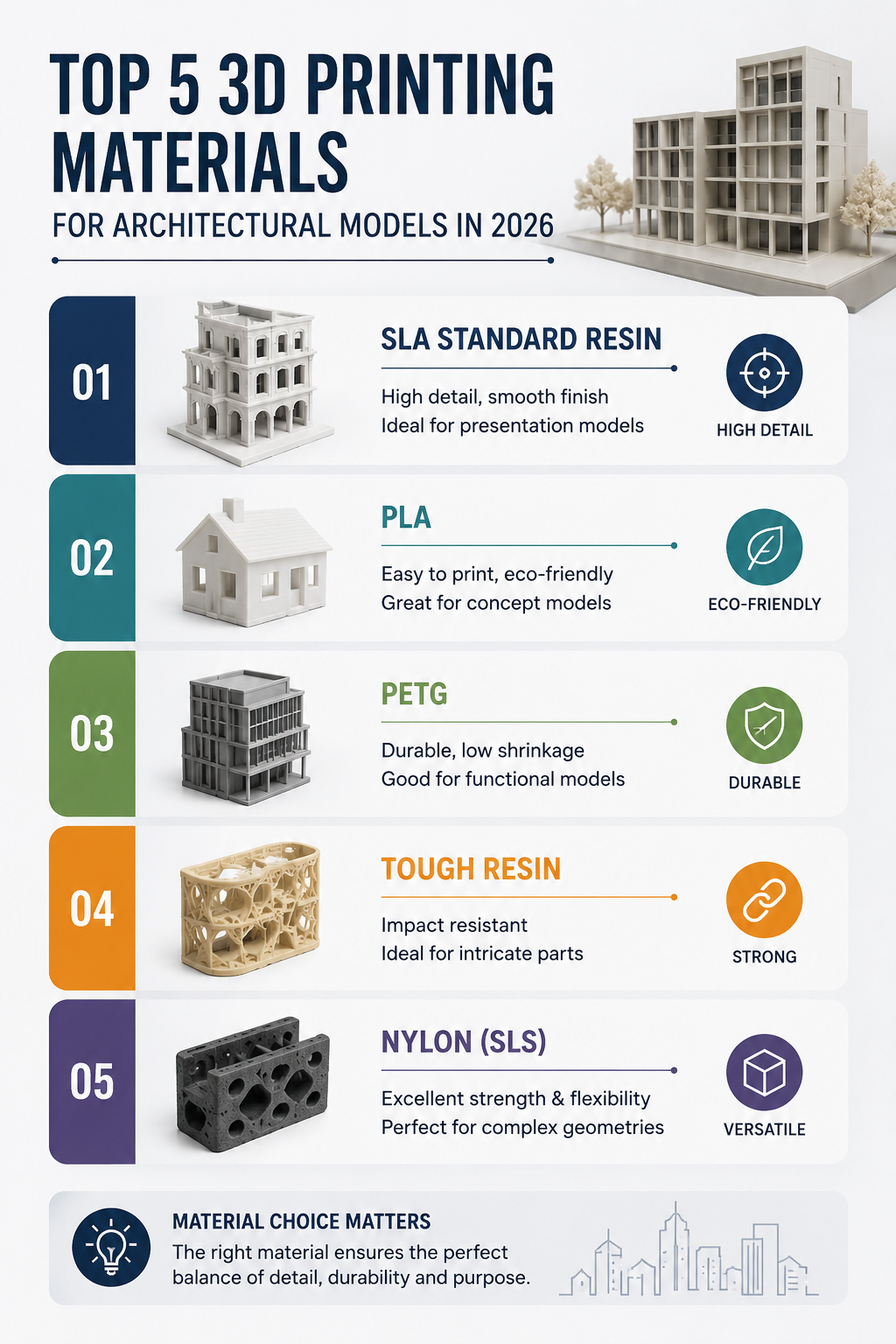
Top 5 Materials for Architectural Models in 2026
1. SLA Standard Resin
Best for: Client presentation models, planning applications, competition entries
SLA resin continues to dominate high-detail 3D printed buildings and presentation models.
At Fixie 3D, approximately 70% of our architectural presentation projects use SLA resin due to its exceptional ability to reproduce fine architectural details.
Advantages
Extremely high resolution (25-50 microns)
Smooth surface finish
Excellent paint adhesion
Superior façade reproduction
Limitations
More brittle than engineering plastics
Requires post-curing
Higher material costs
Fixie 3D Expert Insight
Many failed architectural prints stem from poor file preparation rather than material limitations. Before production, our team routinely repairs thin walls, non-manifold geometry, and unsupported façade features to prevent print failures and preserve design intent.
2. Tough Engineering Resin
Best for: Exhibition models and frequently handled presentation pieces
Tough resin combines the visual quality of SLA with significantly improved durability.
Advantages
Better impact resistance
Excellent dimensional accuracy
Reduced risk of breakage
Professional presentation quality
Limitations
Slightly lower finish quality than standard resin
Higher post-processing effort
This material is particularly valuable for investor presentations and travelling exhibition models where handling risks are higher.
3. PLA Filament
Best for: Sustainable concept models and rapid prototyping architecture
PLA remains one of the most popular FDM materials.
Produced from renewable resources such as corn starch, PLA aligns well with sustainability initiatives increasingly adopted by architecture firms.
Advantages
Affordable
Renewable feedstocks
Fast production
Easy printing
Limitations
Visible layer lines
Lower heat resistance
Reduced fine-detail capability
Ideal applications include:
Early-stage concept models
Urban planning studies
Educational projects
Internal design reviews
4. PETG Filament
Best for: Large-scale architectural models
PETG provides an excellent balance between strength, cost, and ease of production.
Advantages
High durability
Better heat resistance than PLA
Moisture resistance
Excellent for large-format production
Limitations
Lower detail than SLA
Requires careful print tuning
At Fixie 3D, PETG is frequently used for large-scale components and internal structural elements in models approaching our maximum build volume of 750 x 750 x 550 mm.
5. Nylon (SLS)
Best for: Functional architectural prototypes and complex geometries
Nylon remains one of the strongest materials available for professional architectural fabrication.
Advantages
Exceptional durability
No support structures required
Complex geometry capability
Functional testing suitability
Limitations
Rougher surface finish
Higher production costs
More intensive finishing requirements
Nylon excels when creating interlocking assemblies, kinetic architectural concepts, and parametric structures.
Why ABS Didn't Make the Top Five
ABS remains widely recognised in FDM printing.
However, for architectural models, PETG has largely replaced ABS due to:
Lower warping risk
Better dimensional stability
Easier printing
Improved reliability
While ABS offers good strength and heat resistance, it is rarely our first recommendation for professional architectural model making in 2026.
CAD to Physical Model: BIM Integration and Workflow Considerations
Modern architectural workflows increasingly rely on BIM platforms such as Revit, ArchiCAD, and Rhino.
At Fixie 3D, we regularly convert BIM models into printable geometry, helping architects move efficiently from digital coordination models to physical presentation pieces.
Key workflow considerations include:
Remove unnecessary internal geometry.
Verify wall thicknesses.
Separate assemblies strategically.
Simplify highly complex BIM datasets.
Optimise scaling before fabrication.
Proper preparation significantly reduces production costs and avoids delays.
Professional Finishing Makes the Difference
A high-quality architectural model is rarely complete straight off the printer.
Professional finishing typically includes:
Surface preparation
Sanding and priming
Spray painting
Colour zoning
Multi-part assembly
Acrylic glazing installation
Landscape detailing
One of the biggest misconceptions in architectural model making is that the printer alone determines quality.
In reality, finishing often contributes more to perceived value than the print itself.
At Fixie 3D, we regularly use automotive-grade spray finishes and precision assembly techniques to achieve photorealistic finishes suitable for client presentations and marketing displays.
Latest Trends and Innovations in Architectural 3D Printing
Sustainable 3D Printing Materials
Architectural firms are increasingly prioritising sustainable 3D printing materials. PLA, recycled polymers, and lower-waste additive manufacturing workflows continue gaining traction.
Multi-Material Production
Emerging systems allow multiple materials within a single build, creating more realistic landscape and urban representations.
AI-Assisted Design Optimisation
AI-powered design tools are helping architects identify printability issues, optimise geometry, and improve production efficiency before fabrication begins.
Large-Format SLA Printing
Larger resin systems are enabling architects to produce bigger sections with fewer joints, improving appearance and reducing assembly time.
Hybrid Fabrication
The future of architectural model making combines:
SLA printing
FDM printing
CNC machining
Laser cutting
Hand finishing
This hybrid approach delivers the highest quality results while maintaining cost efficiency.
How to Choose the Right Material
If Your Priority Is Maximum Detail
Choose: SLA Resin
If Your Priority Is Sustainability
Choose: PLA
If Your Priority Is Large Scale
Choose: PETG
If Your Priority Is Durability
Choose: Nylon (SLS)
If Your Priority Is Client Presentations
Choose: SLA Resin with Professional Finishing
Frequently Asked Questions
What is the best material for architectural presentation models?
SLA resin remains the preferred choice due to its exceptional detail resolution and smooth finish.
Is SLA better than FDM for architecture models?
For presentation-quality models, yes. For large-scale concept models and cost-sensitive projects, FDM may be more appropriate.
Can BIM models be directly 3D printed?
Yes, but they often require geometry optimisation before production.
How durable are resin architectural models?
Modern tough resins provide excellent durability while maintaining presentation-quality appearance.
What scale works best for 3D printed architectural models?
The ideal scale depends on project goals, but common architectural scales include 1:50, 1:100, 1:200, and 1:500.
Conclusion
Choosing the right material is one of the most important decisions in successful architectural model making.
For intricate client presentation models, SLA resin continues to set the standard. For sustainable concept studies, PLA offers excellent value. PETG excels for large-format models, while Nylon provides unmatched durability for complex functional applications.
At Fixie 3D, we've spent more than 15 years helping architects, developers, and design firms create high-detail 3D printed architectural models that communicate ideas clearly, accelerate approvals, and impress stakeholders. From expert file preparation and BIM optimisation to large-format printing, assembly, spray painting, and NDA-protected workflows, we provide a complete end-to-end architectural model making service.
Ready to transform your CAD model into a stunning physical presentation piece? Contact Fixie 3D today for expert consultation, rapid quotations, and professional architectural model making services tailored to your project.