
How to Choose the Right 3D Printing Technology for Your Project
If you have ever started a 3D printing project without fully thinking through the technology behind it, you will know the frustration that follows. The print comes out with the wrong surface finish. The detail is lost. The material is not quite right for what you had in mind.
Choosing the right 3D printing technology is not a minor technical decision it is the foundation that everything else is built on.
At Fixie 3D, London's specialist in architectural 3D printing, we have spent over 15 years guiding architects, designers, and model makers through exactly this decision. This guide explains the most widely used 3D printing technologies, what each one is best suited for, and how to match your project requirements to the right process.
What to Consider Before Choosing a 3D Printing Technology
Before comparing technologies, it helps to define what your project actually needs. The right choice depends on several critical factors.
Detail and Resolution
For architectural models and presentation pieces, detail matters enormously. If your design includes intricate façade textures, fine structural elements, or precise geometric forms, surface resolution should be your first consideration.
Surface Finish
Surface finish directly affects how professional a model looks before and after post-processing. Some technologies create visible layer lines that require sanding and priming. Others produce smooth surfaces that are ready for spray painting or presentation immediately.
Material Properties
If your model needs to be functional rather than purely visual, material performance becomes essential. Different technologies offer varying levels of:
Rigidity
Flexibility
Heat resistance
Durability
Structural strength
Build Size
Large architectural models often exceed the limits of smaller printers. Build volume determines whether a model can be produced in one piece or needs to be assembled from multiple sections.
Speed and Turnaround Time
Deadlines matter. Some technologies are significantly faster than others, making them more suitable for competition submissions, client presentations, or rapid design iterations.
Cost
Higher-resolution printing technologies generally cost more. However, poor print quality often creates additional costs through reprints, extended finishing work, or missed deadlines.
SLA 3D Printing: The Gold Standard for Detail and Finish
What Is SLA 3D Printing?
Stereolithography (SLA) uses a UV laser to cure liquid resin layer by layer, producing exceptionally detailed models with smooth surfaces.
It is the technology Fixie 3D specializes in because, for architectural model making, few processes can match its combination of precision, consistency, and presentation quality.
Why Architects Choose SLA Printing
SLA is ideal when a project demands:
Fine detail
Smooth surfaces
Professional presentation quality
High paintability
Sharp geometric reproduction
This technology excels at reproducing:
Window mullions
Perforated screens
Curved forms
Geometric cladding
Intricate façade details
The smooth finish produced by laser SLA allows models to accept spray paint with minimal preparation.
Large-Format SLA Capabilities at Fixie 3D
Fixie 3D operates large-format SLA printers with a build volume of:
750 × 750 × 550 mm
This allows us to produce:
Competition models
Urban masterplan models
Multi-piece assemblies
Large-scale presentation models
— all without compromising detail quality.
Limitations of SLA Printing
While SLA offers unmatched visual quality, it does involve trade-offs:
Higher material costs
More expensive production
Limited material flexibility compared to FDM
Less suitable for heavy industrial applications
However, for presentation-quality architectural work, SLA is usually the best option available.
Best Applications for SLA Printing
SLA is best suited for:
Architectural presentation models
Competition entries
Client-facing prototypes
Detailed concept models
High-end visual displays
FDM 3D Printing: Practical, Accessible, and Versatile
What Is FDM Printing?
Fused Deposition Modelling (FDM) is the world's most common 3D printing process. It works by extruding heated thermoplastic filament layer by layer to build a model.
Common FDM materials include:
PLA
ABS
PETG
Nylon
Advantages of FDM Printing
FDM is popular because it is:
Affordable
Fast
Widely available
Material-flexible
It works particularly well for:
Functional prototypes
Structural components
Early-stage design models
Rapid concept testing
Limitations of FDM for Architectural Models
Although practical, FDM has limitations for presentation-quality architecture.
Visible layer lines make it difficult to achieve:
Fine detailing
Smooth surfaces
Crisp edges
Precision textures
Significant sanding and finishing are often required before a model is presentation-ready.
Best Applications for FDM Printing
FDM is best suited to:
Massing models
Concept development
Functional prototypes
Structural test pieces
Budget-conscious projects
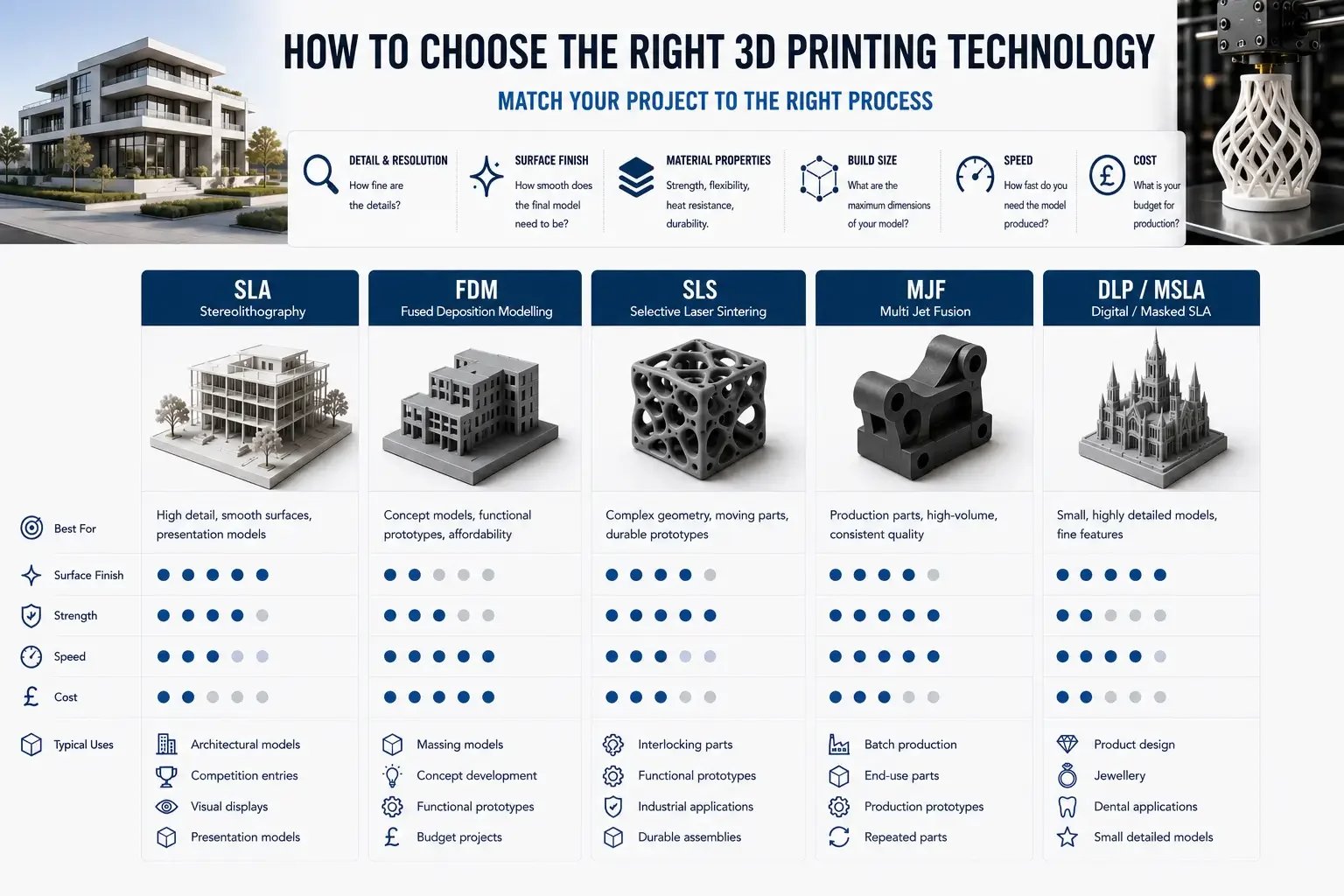
SLS 3D Printing: Complex Geometry Without Support Structures
What Is SLS Printing?
Selective Laser Sintering (SLS) uses a laser to fuse powdered nylon into solid structures.
Unlike SLA and FDM, SLS does not require support structures because surrounding powder supports the print during production.
Why SLS Is Useful
This makes SLS ideal for:
Interlocking assemblies
Internal voids
Moving parts
Organic geometries
Complex engineering forms
SLS produces strong, durable parts with consistent structural performance.
Surface Finish and Architectural Use
SLS surfaces are slightly grainy compared to SLA but more consistent than FDM.
For architecture, SLS is useful when models must withstand repeated handling or contain geometries difficult to achieve using other technologies.
Best Applications for SLS Printing
SLS is ideal for:
Complex geometries
Functional prototypes
Interlocking components
Industrial applications
Durable model assemblies
Multi Jet Fusion (MJF): Fast Production at Scale
What Is MJF Printing?
Multi Jet Fusion (MJF), developed by HP, is another powder-based printing technology similar to SLS.
Instead of a laser, MJF applies:
A fusing agent
A detailing agent
Heat activation
This enables faster and more consistent production.
Strengths of MJF Printing
MJF excels when producing:
Multiple identical parts
Functional components
Production-ready prototypes
High-volume batches
Mechanical consistency across builds is one of its major strengths.
Best Applications for MJF Printing
MJF is best suited to:
Batch manufacturing
End-use components
Production prototypes
Repeated functional parts
Resin Technologies Beyond SLA: DLP and MSLA
What Are DLP and MSLA?
Digital Light Processing (DLP) and Masked Stereolithography (MSLA) are resin-based technologies related to SLA.
DLP uses a digital projector MSLA uses an LCD mask with UV lighting
Both cure resin layer-by-layer similarly to SLA.
Advantages and Limitations
These systems can be faster for smaller builds and are increasingly common in desktop resin printers.
However, compared to industrial laser SLA, they generally offer:
Smaller build volumes
Less consistency
Reduced scalability
Best Applications for DLP and MSLA
These technologies work well for:
Small detailed models
Product design
Jewellery
Dental applications
Hobbyist printing
How to Match Your Project to the Right 3D Printing Technology
Choosing the right process becomes easier when priorities are clear.
Choose SLA If:
Surface finish matters most
You need presentation-quality results
Fine detail is critical
The model will face clients or juries
Choose FDM If:
Speed and affordability are priorities
You are testing early-stage concepts
Surface finish is less important
Choose SLS or MJF If:
Geometry is highly complex
Parts must be durable
Assemblies include moving or interlocking elements
You require functional performance
Why Architectural Models Demand Higher Standards
Architectural models are not simply scaled objects they are communication tools.
They help communicate:
Design ambition
Spatial relationships
Material intent
Architectural quality
A rough or inaccurate model weakens the design it represents. A crisp, professionally finished model strengthens it.
That is why surface finish, precision, and presentation quality are essential in architectural model making.
Working with Fixie 3D
From CAD File to Finished Architectural Model
Preparing files for 3D printing can be challenging. CAD and BIM files are designed for documentation, not manufacturing.
Successful printing often requires adjustments to:
Wall thickness
Mesh integrity
Geometry optimisation
Structural support planning
At Fixie 3D, file preparation is part of our process.
We regularly work with:
Rhino
Revit
BIM exports
CAD assemblies
Complex architectural datasets
Our Workflow
Our process is straightforward:
Upload your model or drawings
We review and optimise the files
We recommend the right printing technology
Models are printed and assembled
Professional finishing is completed
Your project is delivered on schedule
We also support fast-turnaround architectural deadlines for competitions and client presentations.
Conclusion
Choosing the right 3D printing technology comes down to understanding your project priorities.
SLA delivers unmatched detail and finish FDM offers speed and affordability SLS and MJF unlock complex functional geometries
For architectural presentation models where visual quality matters, SLA remains the benchmark technology.
The most important step, however, is getting expert guidance before production begins.
If you are planning a project and want help selecting the right approach, the Fixie 3D team is here to help.
Architectural practices investing in 3D printing technology can explore Innovate UK manufacturing funding to offset the cost of high-resolution production processes.
About Fixie 3D
Fixie 3D is London's specialist in architectural 3D printing and model making, with over 15 years of experience supporting leading architectural practices across the UK.
Services include:
SLA 3D printing
File preparation
Professional finishing
Architectural model making
Competition model production