
Comparing 3D Printing Technologies: FDM vs. SLA for Architects
Introduction
3D printing has transformed the architectural industry by allowing architects to bring concepts, models, and prototypes into the physical world with incredible speed and precision. From conceptual massing studies to highly detailed presentation models, additive manufacturing has become an essential part of modern architectural workflows.
Among the many 3D printing technologies available today, FDM (Fused Deposition Modeling) and SLA (Stereolithography) remain the two most widely used options for architects. Both technologies offer unique advantages, but choosing the right one depends on project requirements, budget, model complexity, material expectations, and presentation goals.
For architects, selecting the wrong technology can lead to:
Poor surface quality
Increased production costs
Longer print times
Structural weaknesses
Limited design detail
This guide compares FDM vs. SLA for architectural applications, helping architects understand which technology best suits their design, prototyping, and client presentation needs.
What Is FDM 3D Printing?
FDM (Fused Deposition Modeling) is one of the most common and affordable 3D printing technologies.
It works by:
Heating thermoplastic filament
Extruding material layer by layer
Building the object from the bottom upward
Common FDM materials include:
PLA
ABS
PETG
TPU
FDM printers are widely used because they are:
Affordable
Easy to operate
Suitable for large models
Cost-effective for rapid prototyping
For architecture firms, FDM is often the first step into professional 3D printing.
What Is SLA 3D Printing?
SLA (Stereolithography) uses liquid photopolymer resin cured by a UV laser or light source.
Instead of melting filament, SLA:
Uses a resin vat
Cures resin layer by layer
Produces extremely fine details and smooth surfaces
SLA printing is known for:
High precision
Exceptional detail
Smooth finishes
Professional-quality prototypes
Architects frequently use SLA for:
High-end presentation models
Intricate façade details
Interior layouts
Complex geometries
Why 3D Printing Matters for Architects
Architectural firms increasingly rely on 3D printing because it improves:
Client presentations
Design communication
Iteration speed
Visualization accuracy
Collaboration efficiency
Research within architecture and digital fabrication industries shows that physical models often improve client understanding more effectively than digital renders alone.
3D architectural models help stakeholders:
Understand spatial relationships
Evaluate design proportions
Review urban context
Visualize structural concepts
Both FDM and SLA contribute significantly to this process but in different ways.
FDM vs. SLA: Key Differences for Architects
1. Print Quality & Surface Finish
FDM
FDM printers create visible layer lines due to the extrusion process.
Advantages:
Good for conceptual models
Suitable for early-stage design studies
Acceptable for functional prototypes
Limitations:
Rougher surface texture
Less refined details
Post-processing often required
SLA
SLA produces extremely smooth surfaces with fine details.
Advantages:
Presentation-quality models
Sharp architectural details
Cleaner visual aesthetics
Limitations:
More delicate prints
Additional resin handling required
Best Choice for Architects
Conceptual prototyping: FDM
Client presentation models: SLA
2. Precision & Detail
FDM
FDM is effective for larger geometric forms but struggles with:
Tiny features
Thin walls
Intricate façade details
SLA
SLA excels in:
Fine textures
Complex geometries
Detailed ornamentation
Miniature architectural components
For projects involving:
Luxury interiors
Historic restoration
Detailed urban models
SLA often delivers superior visual quality.
Winner for Precision ✅ SLA
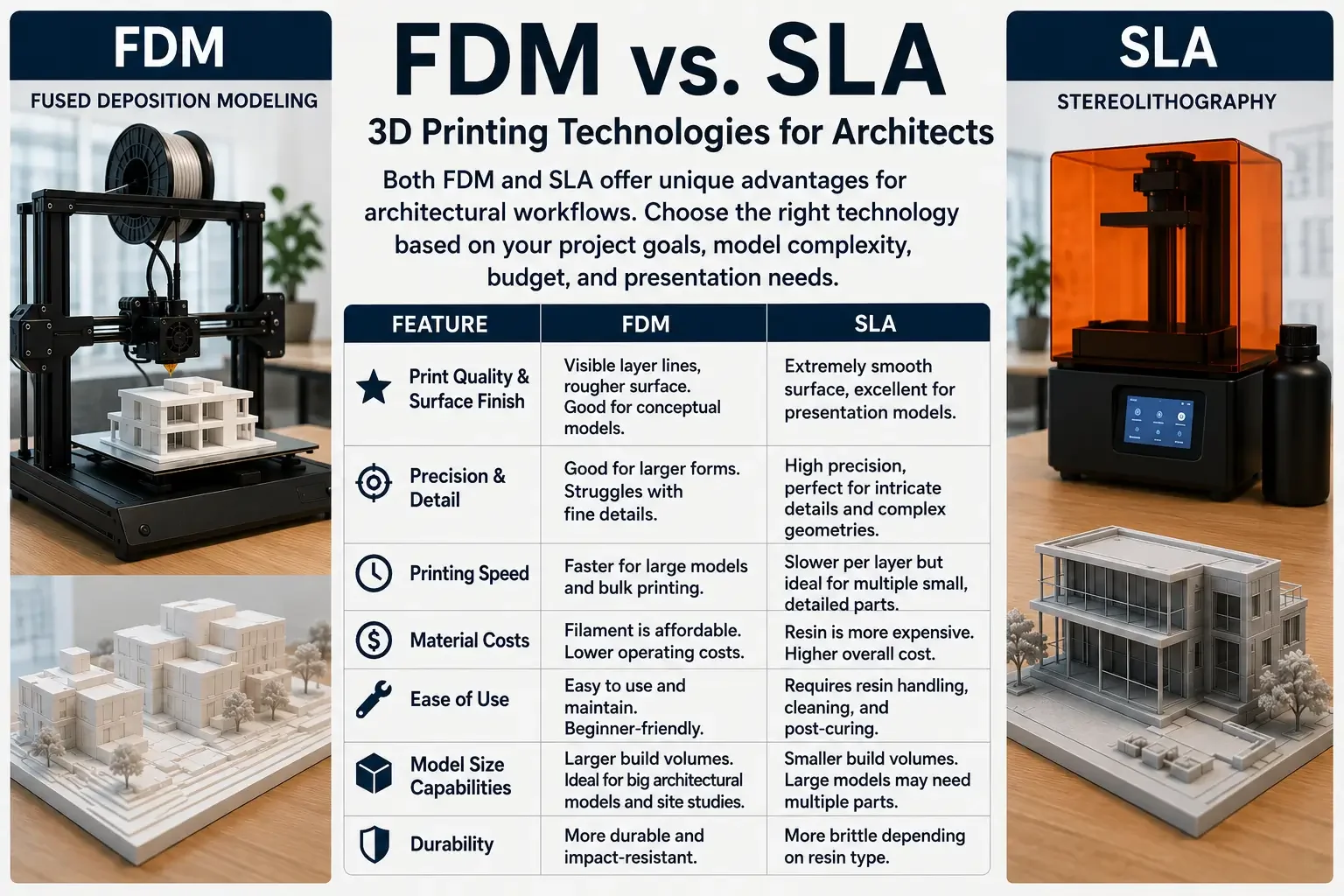
3. Printing Speed
FDM
FDM can print large models relatively efficiently.
Advantages:
Faster for bulkier objects
Easier scaling for conceptual models
SLA
SLA can be slower depending on:
Resin curing
Post-processing
Support removal
However, SLA often prints multiple small parts efficiently at once.
Best Use Case
Large conceptual models → FDM
Small detailed components → SLA
4. Material Costs
FDM
FDM is generally more affordable.
Filament materials cost less than resin, making FDM ideal for:
Frequent prototyping
Large-volume printing
Budget-conscious studios
SLA
Resin materials are typically more expensive.
Additional costs may include:
Cleaning stations
UV curing equipment
Safety accessories
Winner for Cost Efficiency ✅ FDM
5. Ease of Use
FDM
FDM printers are widely considered beginner friendly.
Advantages:
Easier setup
Simpler maintenance
Lower learning curve
SLA
SLA requires:
Resin handling
Post-curing
Cleaning procedures
Safety precautions
Architectural studios with dedicated fabrication teams may manage SLA more easily than smaller firms.
Winner for Simplicity ✅ FDM
6. Model Size Capabilities
FDM
FDM printers often support:
Larger build volumes
Bigger architectural massing models
This makes FDM highly practical for:
Urban planning models
Site studies
Large-scale conceptual designs
SLA
SLA printers usually have smaller build areas.
Larger models may require:
Multiple printed sections
Assembly after printing
Winner for Large Models ✅ FDM
7. Durability
FDM
FDM materials tend to be more durable and impact resistant.
Good for:
Frequent handling
Educational environments
Transportable models
SLA
SLA prints are more detailed but can be brittle depending on resin type.
Better suited for:
Display models
Presentation pieces
Fine-detail prototypes
Winner for Durability ✅ FDM
Which Technology Is Better for Architects?
The answer depends entirely on project goals.
Choose FDM If You Need:
Affordable prototyping
Large conceptual models
Fast iterations
Durable study models
Lower operating costs
Choose SLA If You Need:
High-detail presentation models
Smooth finishes
Intricate architectural details
Luxury project visualization
Professional client presentations
Many architecture firms now combine both technologies within the same workflow.
Hybrid Workflows: The Future of Architectural 3D Printing
Modern architecture studios increasingly use:
FDM for early-stage development
SLA for final presentation models
This hybrid approach balances:
Speed
Cost
Detail
Efficiency
For example:
Urban massing printed with FDM
Detailed building façades printed with SLA
Combining technologies often creates the best overall workflow.
Emerging Trends in Architectural 3D Printing
Research in digital fabrication shows rapid growth in:
Multi-material printing
Sustainable materials
AI-assisted model preparation
High-speed resin systems
Automated post-processing
Architects are also increasingly integrating 3D printing with:
BIM workflows
Parametric design
Computational architecture
Generative design systems
As technology evolves, both FDM and SLA continue improving in:
Print quality
Material performance
Speed
Accessibility
Final Thoughts
Both FDM and SLA offer valuable advantages for architects, but each serves different purposes within the design and presentation process.
FDM remains the practical choice for:
Rapid prototyping
Affordable workflows
Large conceptual studies
SLA stands out for:
Precision
Professional presentation quality
Fine architectural detailing
Rather than viewing FDM vs. SLA as a strict competition, many successful architecture firms now treat them as complementary tools within a broader digital fabrication strategy.
By understanding the strengths and limitations of each technology, architects can improve:
Design communication
Client engagement
Workflow efficiency
Physical model quality
As architectural visualization continues evolving, 3D printing will remain a central part of modern design practice.
As architectural projects become more complex, Building Information Modelling (BIM) helps teams coordinate design, construction, and documentation more efficiently throughout the project lifecycle.
Frequently Asked Questions
Which 3D printing technology is best for architectural models?
FDM is ideal for conceptual and large-scale models, while SLA is better for highly detailed presentation models.
Is SLA more accurate than FDM?
Yes, SLA generally provides higher precision and smoother surfaces than FDM.
Why do architects use FDM printers?
FDM printers are affordable, durable, and excellent for rapid prototyping and large conceptual studies.
Is SLA expensive for architecture firms?
SLA typically has higher material and maintenance costs but delivers superior visual quality.
Can architects use both FDM and SLA together?
Yes, many firms combine both technologies to balance cost, speed, and detail quality.