
AI-Driven File Optimization for Architectural 3D Prints: How Architects Are Reducing Material Use While Building Stronger Models in 2026
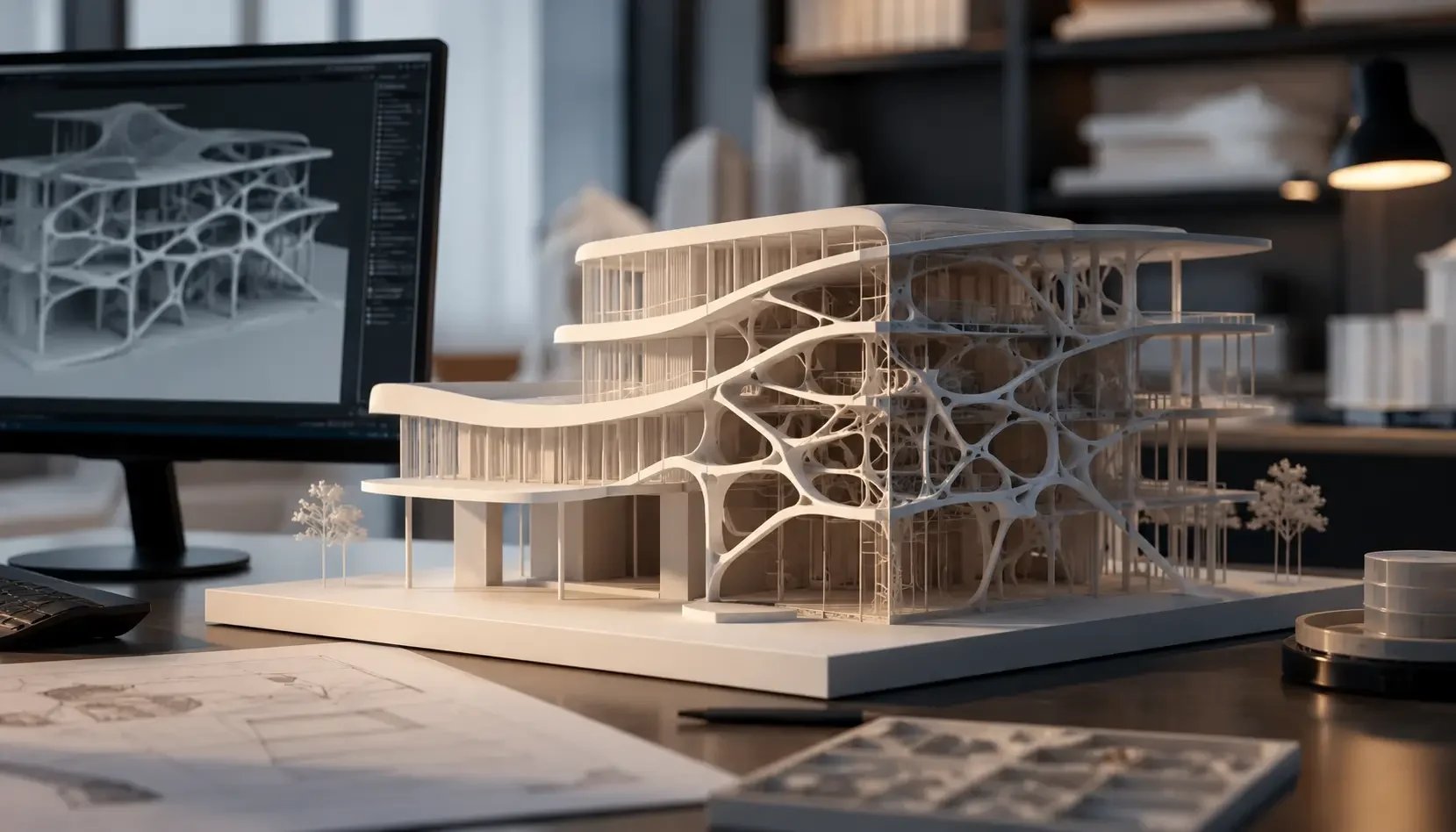
The Hidden Cost Problem in Architectural 3D Printing
Architectural firms are under increasing pressure to deliver highly detailed physical models faster, cheaper, and with greater visual impact than ever before. Whether preparing for a client presentation, a planning submission, or a design competition, architects often rely on large-format 3D printing to bring concepts to life.
However, many firms encounter the same challenges:
Rising resin and material costs
Long print times for large-scale models
Fragile components that break during transport
Heavy models that are difficult to ship and assemble
Tight deadlines that leave little room for failed prints
The reality is that many architectural 3D print files are not optimized for additive manufacturing. They contain excess material, inefficient geometry, and structural features that increase cost without improving performance.
This is where artificial intelligence is changing the game.
By combining AI-driven topology optimization, generative design, and advanced large-format Stereolithography (SLA) printing, architectural practices can now create models that are lighter, stronger, more sustainable, and significantly more cost-effective.
For forward-thinking firms, AI-driven file optimization is no longer an experimental technology. In 2026, it is becoming a competitive advantage.
What Is AI-Driven File Optimization?
AI-driven file optimization uses advanced algorithms to analyze a 3D model and determine where material is actually needed.
Instead of treating every part of a model equally, AI evaluates:
Structural requirements
Stress distribution
Printability constraints
Material behavior
Manufacturing limitations
The software then removes unnecessary material while maintaining the model's strength and appearance.
Think of it as intelligent weight reduction.
Just as nature creates lightweight but incredibly strong structures in bones, trees, and honeycombs, AI optimization applies similar principles to architectural models.
The result is a geometry that uses less material while often performing better than the original design.
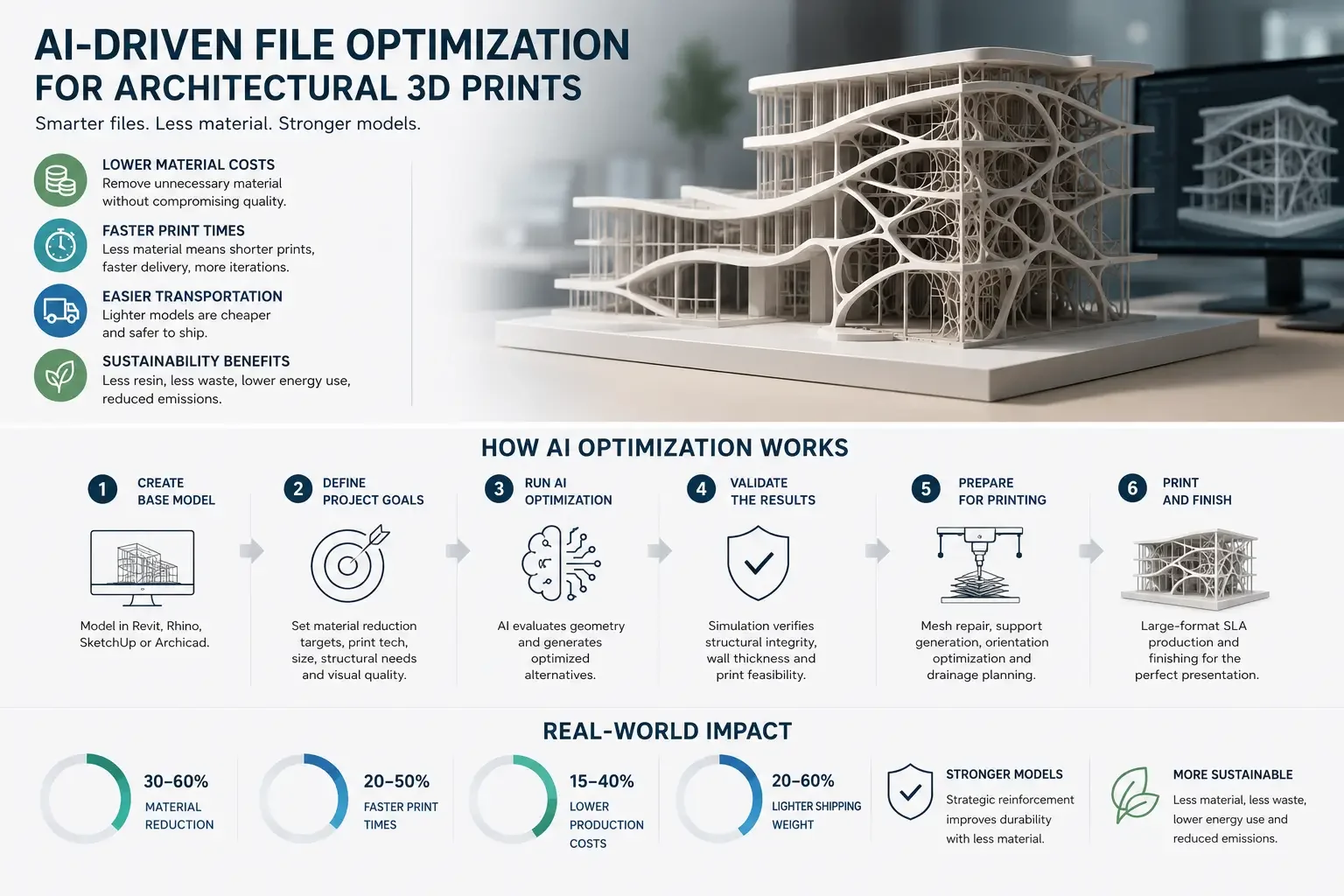
Many optimized architectural models achieve material reductions of 30–60%, depending on complexity and scale.
Why Architects Are Adopting AI Optimization
Lower Material Costs
Resin remains one of the most significant expenses in professional SLA printing.
When a large urban planning model requires several liters of resin, material costs can quickly escalate.
AI optimization identifies areas where material contributes little to performance and safely removes it.
For large-format architectural models, this often translates into substantial cost savings without compromising visual quality.
Faster Print Times
Every cubic centimeter removed from a model reduces print duration.
Shorter print times create several advantages:
Faster project delivery
More iterations before deadlines
Reduced machine occupation
Lower production costs
For architecture firms working on multiple projects simultaneously, these efficiency gains can be significant.
Easier Transportation
Many competition and presentation models travel long distances.
Heavy models are more expensive to ship and more vulnerable to damage.
Optimized models weigh considerably less while maintaining rigidity, making transportation safer and more economical.
Sustainability Benefits
Sustainability is becoming a key consideration across architecture and construction.
Reducing resin consumption directly lowers:
Manufacturing energy consumption
Shipping emissions
Overall environmental impact
This aligns with broader industry goals surrounding sustainable design and responsible fabrication practices.
Understanding the Technologies Behind AI Optimization
Topology Optimization
Topology optimization is one of the most powerful tools in modern digital manufacturing.
The process begins by defining:
Design space
Constraints
Desired performance targets
The algorithm then evaluates stress pathways throughout the model.
Areas experiencing little or no structural demand are gradually removed.
The final result often resembles organic forms found in nature because nature itself has evolved highly efficient structures over millions of years.
For architectural model making, topology optimization can dramatically reduce material usage while preserving essential strength.
Generative Design
Generative design takes optimization a step further.
Instead of producing one solution, AI generates thousands of alternatives based on specific project objectives.
Architects can define criteria such as:
Minimum weight
Maximum strength
Manufacturing constraints
Aesthetic requirements
Material limitations
The software explores countless design possibilities and presents the highest-performing options.
This approach allows architects to discover innovative solutions that traditional modeling methods may never reveal.
Additive Manufacturing-Aware Optimization
Recent advances in AI optimization are specifically designed for 3D printing.
Modern software considers factors such as:
Layer adhesion
Support requirements
Build orientation
Self-supporting angles
Material-specific performance characteristics
This ensures that optimized models are not only lightweight but also practical to manufacture.
How AI Optimization Improves Architectural Models
Architectural models differ from engineering components.
They are primarily visual communication tools rather than load-bearing structures.
Yet they still require durability.
Models are frequently:
Transported
Handled by clients
Assembled from multiple sections
Displayed for extended periods
AI optimization improves these models in several ways.
Internal Lightweight Structures
Advanced software can create lattice networks inside hollow sections.
These structures maintain rigidity while dramatically reducing resin usage.
Strategic Reinforcement
Instead of adding material everywhere, AI concentrates reinforcement only where necessary.
This targeted approach often produces stronger models despite lower overall material consumption.
Improved Assembly Performance
Large architectural models are commonly printed in sections.
Optimization helps reduce weight while maintaining dimensional accuracy, simplifying assembly and installation.
The Workflow: From BIM Model to Optimized Print
A successful AI optimization workflow typically follows six stages.
Create the Base Model
Most projects begin in software such as:
Revit
Rhino
SketchUp
Archicad
The model is then exported for optimization.
Define Project Goals
Key considerations include:
Desired material reduction
Print technology
Model size
Structural requirements
Visual quality expectations
Run AI Optimization
The software evaluates geometry and generates optimized alternatives.
Architects can compare different solutions based on performance metrics.
Validate the Results
Simulation tools verify:
Structural integrity
Wall thickness
Manufacturing feasibility
This step ensures reliability before production begins.
Prepare for Printing
Specialized software prepares the model through:
Mesh repair
Support generation
Orientation optimization
Drainage planning
Print and Finish
The optimized model moves into production using large-format SLA systems before receiving finishing treatments such as:
Sanding
Priming
Painting
Material-effect finishing
Real-World Impact: What Firms Are Achieving
Across the architectural visualization sector, optimized workflows are producing measurable results.
Typical improvements include:
30–60% material reduction
Significant print-time savings
Lower production costs
Reduced shipping weight
Improved model durability
For competition models and large urban planning presentations, these benefits can directly influence project profitability and delivery speed.
As client expectations continue to rise, optimization enables firms to produce more ambitious physical models without proportionally increasing costs.
Expert Insight from Fixie3D
At Fixie3D, AI-driven optimization forms part of a broader strategy to improve both manufacturing efficiency and model quality.
Led by Michelle Greeff, a 3D printing specialist with extensive experience in architectural model production, the team works with architects, developers, and designers to transform complex digital models into highly detailed physical representations.
Rather than simply printing files as received, the process focuses on evaluating geometry, printability, structural efficiency, and finishing requirements before production begins.
This optimization-first approach helps clients:
Reduce unnecessary material use
Improve model durability
Shorten production timelines
Achieve superior presentation quality
As architectural projects become increasingly complex, expert file preparation is often the difference between a successful model and an expensive production challenge.
Challenges Architects Should Consider
Despite its benefits, AI optimization is not a fully automated solution.
Several challenges remain.
Learning Curve
Advanced optimization software requires training and experience.
Over-Optimization
In some cases, excessive material reduction can introduce manufacturing difficulties.
Complex Support Requirements
Organic geometries may increase support structures if not properly managed.
Validation Needs
Every optimized design should be reviewed digitally and physically before final production.
The best outcomes occur when AI recommendations are combined with human expertise.
The Future of Architectural 3D Printing
The next phase of architectural fabrication is already emerging.
Between now and 2030, architects can expect:
AI-Native CAD Systems
Design software will increasingly accept natural-language instructions such as:
"Reduce material use by 40% while maintaining presentation quality."
Real-Time Optimization
AI will optimize geometry continuously during the design process.
Multi-Material Intelligence
Future systems will automatically assign different materials to specific areas of a model.
Cloud-Based Design Exploration
Smaller firms will gain access to enterprise-level optimization capabilities without expensive hardware investments.
Integration with Digital Twins
Physical models and digital project data will become increasingly connected throughout project lifecycles.
Conclusion
Architectural model making is entering a new era.
AI-driven file optimization allows architects to produce lighter, stronger, faster, and more sustainable 3D printed models while significantly reducing material consumption and production costs.
What once required extensive manual engineering can now be achieved through intelligent algorithms that understand geometry, manufacturing constraints, and performance requirements.
For architectural firms seeking a competitive advantage in 2026, optimization is rapidly becoming as important as the printing technology itself.
The firms that embrace AI-enhanced workflows today will be better positioned to deliver exceptional physical models tomorrow.
Many architects are adopting material-efficient workflows that align with Sustainable Design and Construction Guidance, supporting more sustainable design and construction practices.
Ready to Optimize Your Next Architectural Model?
Before sending your next file to print, consider what AI-driven optimization could achieve.
A professional file review can often reveal opportunities to reduce material use, shorten production time, and improve overall model performance without compromising design intent.
At Fixie3D, every successful print starts with a smarter file.